Skip to content
Magenta Ong.

An LLM-powered authoring platform that turns a topic brief and reference material into an editable course draft.

Jan 2025 - Jan 2026

GenEd identity slide for the SUTD BabyShark Fund project

What happened

Most LMSes are built by people who teach with assumption that students have a basic understanding of (blank). We built GenEd for the slow bit before that, where an educator OR student who is interested in learning a topic, gives their learning objectives, and sometimes their own reference material to GenEd. GenEd then returns a course outline, modules, and quiz variants that they could review and rewrite.

SUTD’s Venture, Innovation and Entrepreneurship office gave us the S$6,000 Baby Shark Grant. We got an MVP, and put it in front of beta users, and came kinda close to a live deployment.

LMSes for educators

A subject-matter expert may know exactly what to teach and still not have days or time to turn it into a structured online course. Delivery platforms didn't really fix that authoring work. GenEd was our attempt to make the first draft take minutes or even seconds while leaving the educator in charge of what was published. This worked rather well for me, as being a private tutor helped me to know what the painpoints of an educator is.
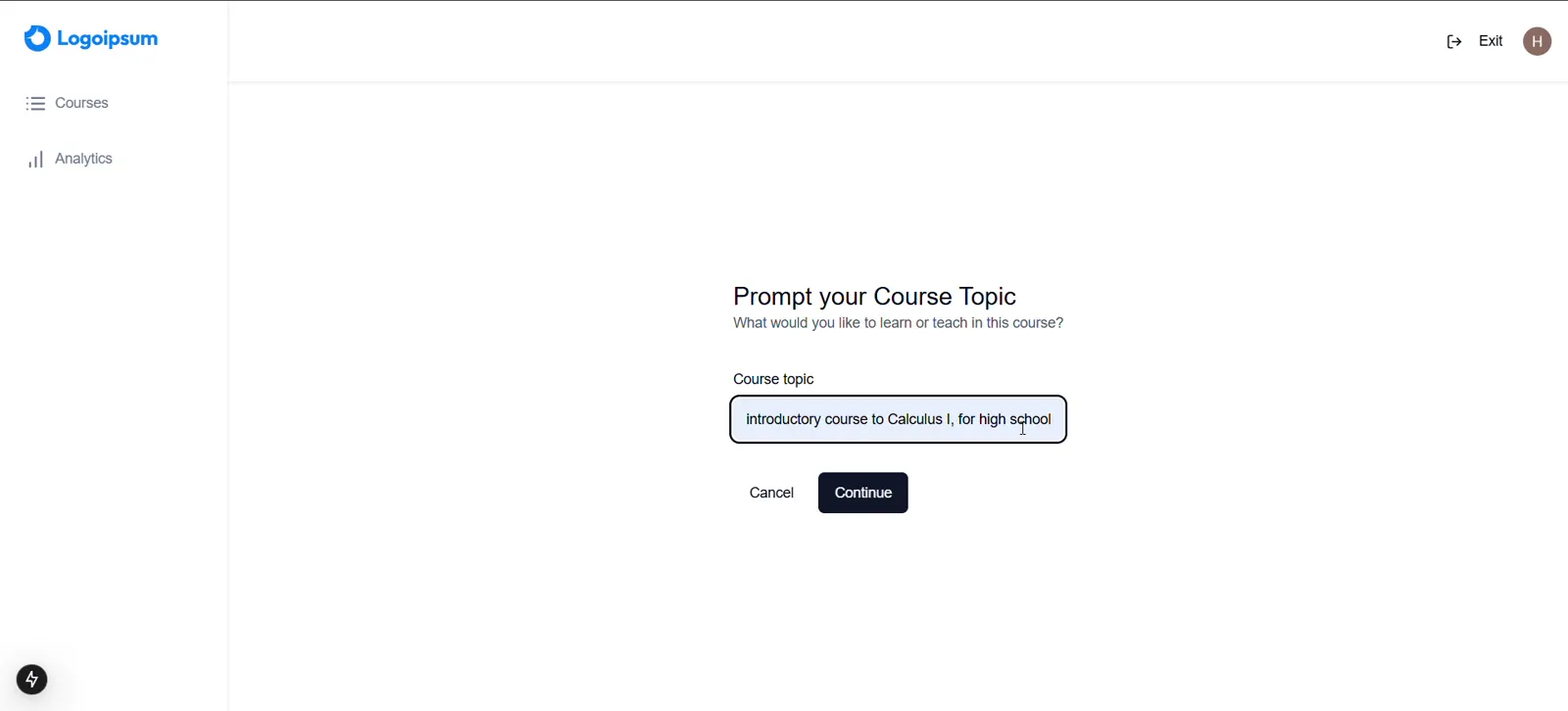
GenEd prototype asking an educator for a course topic
The prototype asks for a course topic before generating a first draft. The Logoipsum mark stayed in the original recording.

LMSes for students

For students, the main struggle is that courses out there are not personalised and catered for the general public. A student might excel in mathematical reasoning, but fail at explaining the concept in words, vice versa. But a course is more likely to focus on the mathematical logic rather than explanation, when sometimes what a student needs is to know how to explain their thoughts. This is where GenEd comes in, it's meant to be personalised towards a student's learning style and habits as well as preferences, making microlearning (and learning) more accessible and fun.

One course was several smaller LLM calls

The generated course is done through several LLM calls, allowing for the module titles, quizzes, and content to be more predictable and let an educator or student regenerate one weak section without discarding everything else.

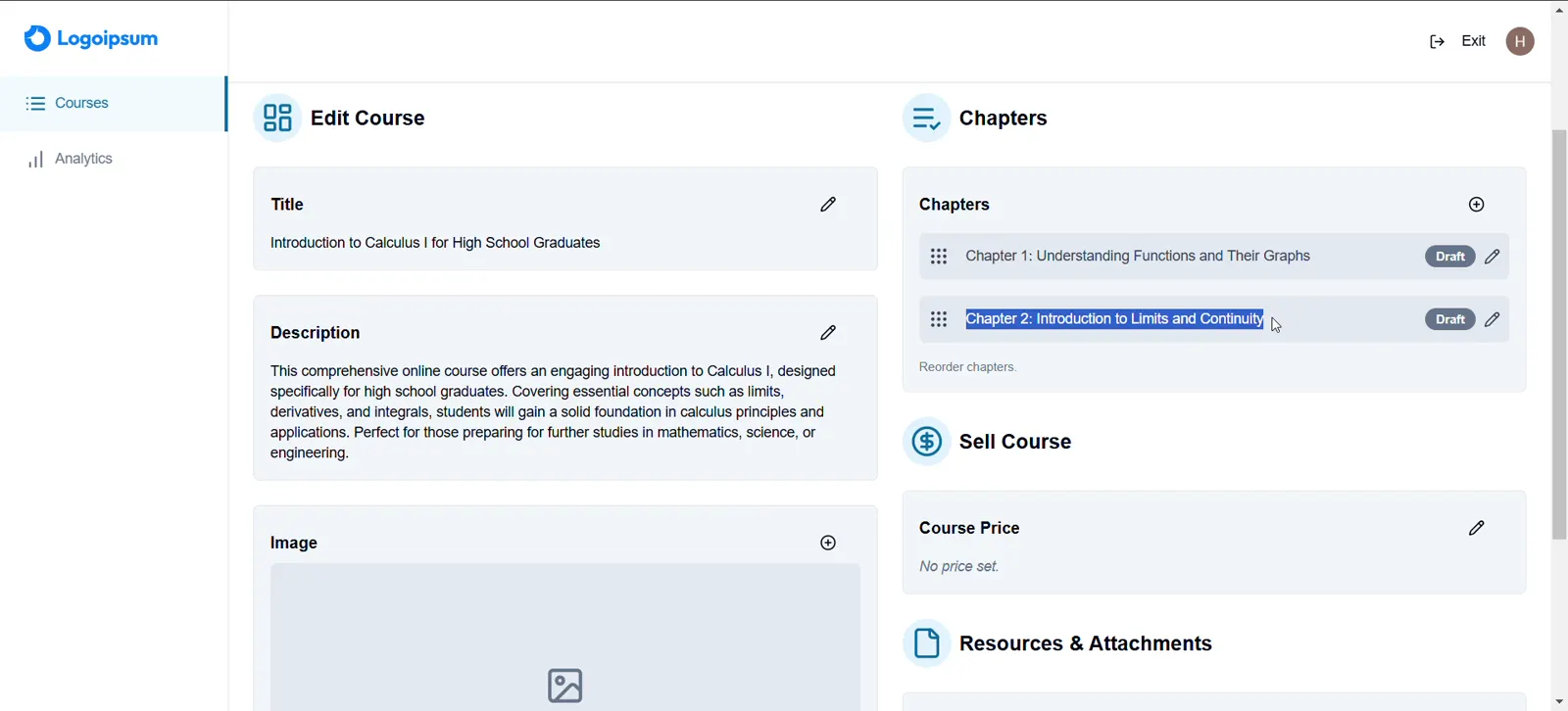
GenEd editor with editable course details and chapter drafts
Generated titles, descriptions, and chapters remained editable in the prototype.

Rough prototype capture—placeholder branding included.

A 49-second recording moving from the course list to an AI course prompt, then into an editable draft with title, description, chapters, pricing, and resources.

PDFs kept the source material close

When an educator uploaded PDFs or supplied URLs, we chunked and embedded the material, retrieved relevant passages, and added them to the generation context. It kept domain-specific courses closer to the educator’s sources, but sadly, this didn't manage to make hallucination disappear. As a result, we made it such that every module would be passed through a human review step before publication.

We also tried it inside WhatsApp, to encourage microlearning

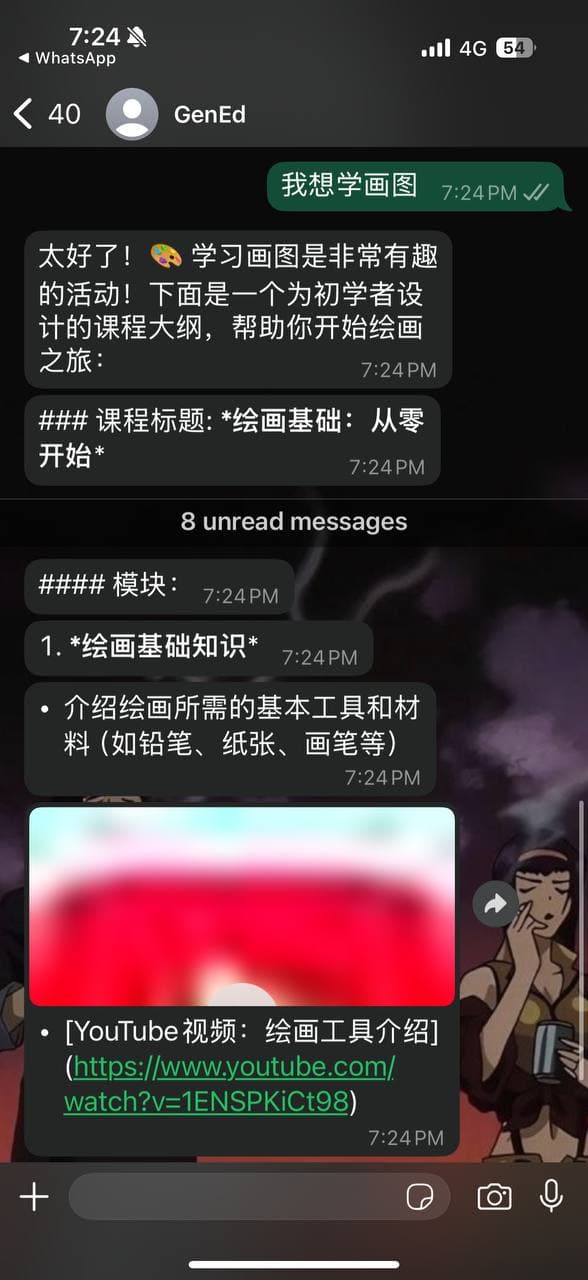
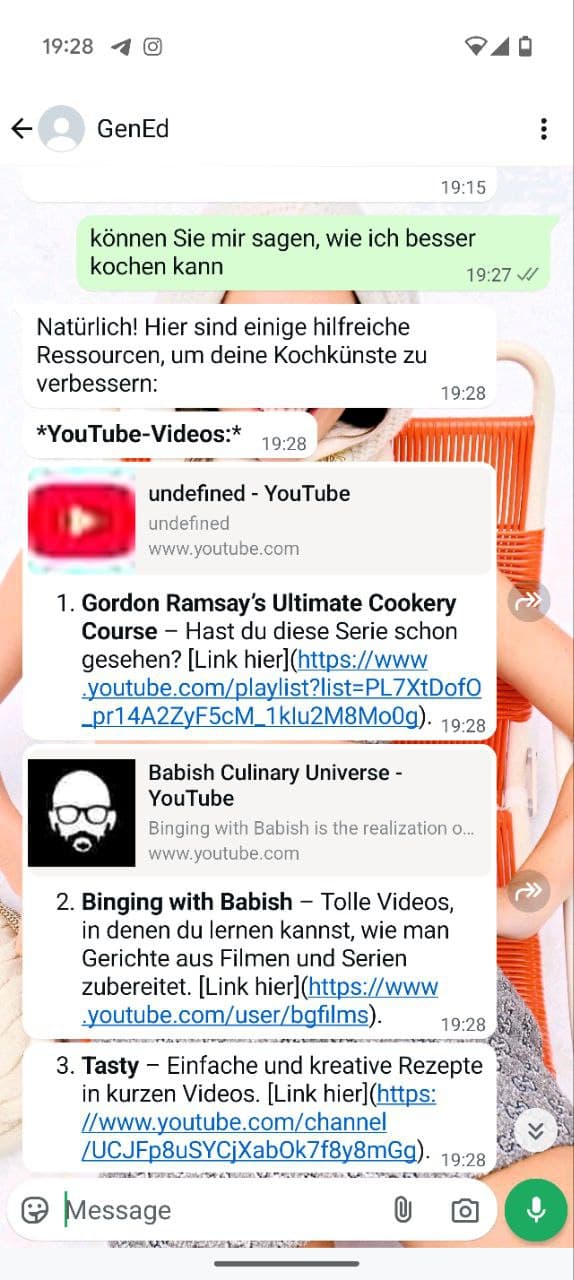
We used Twilio APIs to test what GenEd could look like as a WhatsApp microlearning bot. These English, Chinese, and German runs returned useful links and small next steps without asking the learner to open another platform. It works in other languages too, and was pretty successful as a first pass. This caught the eye of a collaborator who was backed by the Malaysian Government, and allowed us to receive an initial Letter of Intent.

English-language test: the bot returns public-speaking videos, articles, and practice tasks inside WhatsApp.

A short screen recording of the Twilio-powered bot.

WhatsApp conversation with GenEd responding in Chinese with a beginner drawing course outline
Chinese-language test: a request to learn drawing returns a beginner course outline.
WhatsApp conversation with GenEd responding in German with cooking video resources
German-language test: a request to improve at cooking returns a set of video resources.

However, given that time was running out, we chose to take a step back.

It was a tough decision to make, but when SUTD’s VIE office closed the funding window, the three of us decided not to seek more capital. The product worked; but making it reliable enough for real courses was a much larger job. We took the experience with us instead of stretching the project past the point where the team wanted to keep going. The project continues to live through SUTD's undergraduate research project, where we explore more AI-driven PDF-to-course generation, since this was our main bottleneck during beta testing.

Where it got tough

  • An AI-written course can sound finished while being factually wrong. RAG and educator review reduced the risk but it's still not entirely reliable.

  • The problem with AI powered products is that it depends on the AI, and at the point of development the AI we used wasn't exactly the best. We had to pivot the project into research to get an even more accurate and reliable product.

  • A production-grade setup requires more time than what the funding window gave and is definitely a huge challenge for us.